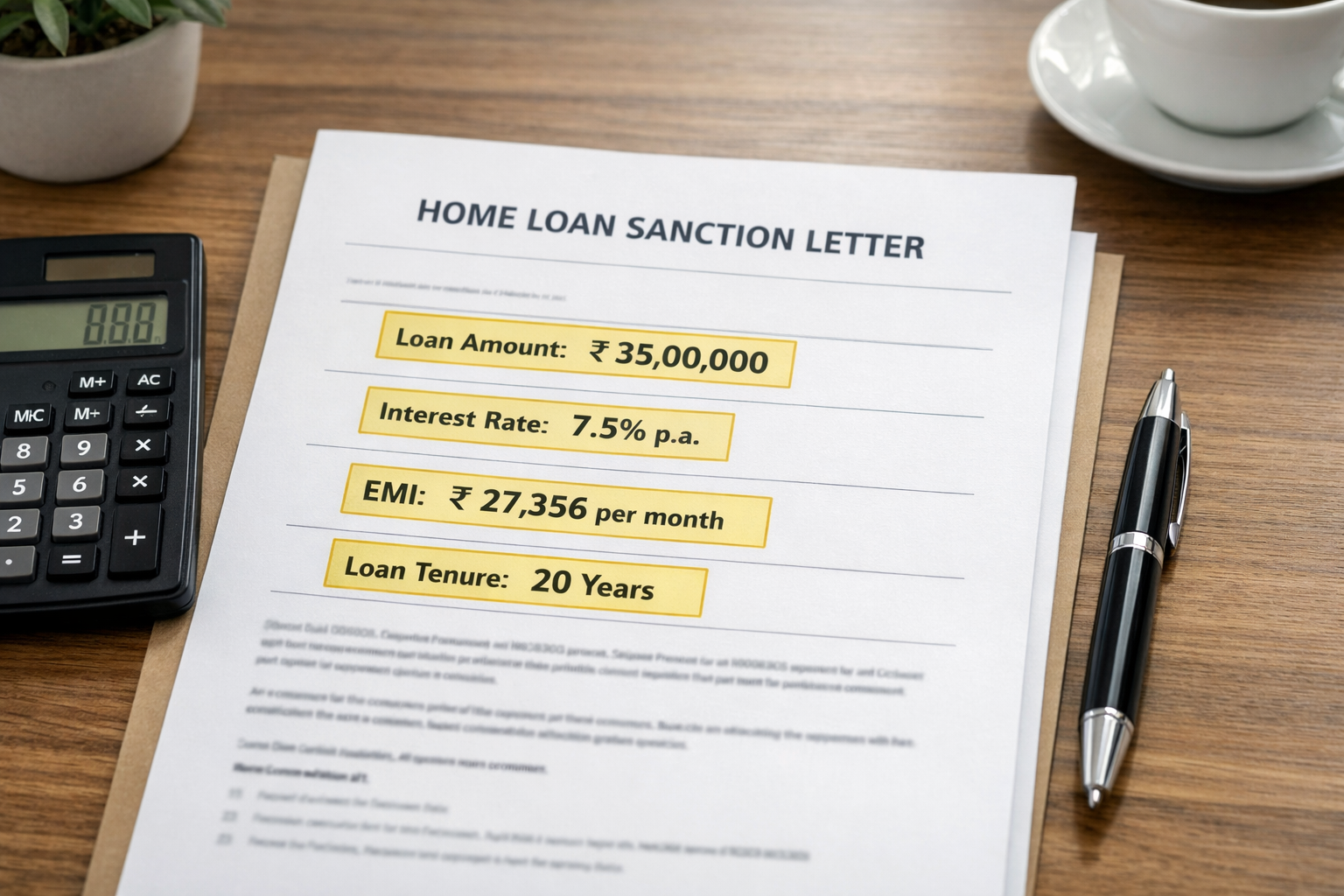
How to Read Your Home Loan Sanction Letter: The 9 Numbers That Truly Matter
| Reading Time | Audience | Topic | Last Updated |
| 8 min | Home Loan Borrowers | Sanction Letter | 2026 |
The average Indian home loan borrower spends more time reading a restaurant menu than their sanction letter. Yet inside that 4-page document are 9 numbers that will collectively determine whether they pay ₹30 lakhs or ₹55 lakhs in total interest over 20 years. Here is what each number means — and what to do about it before you sign.
Most borrowers treat the sanction letter as a formality — a green flag from the bank that the money is coming. That is a costly mistake. Having spent 20+ years on the other side of the desk — issuing and structuring these letters at Axis Bank and Deutsche Bank — I can tell you with certainty: banks write sanction letters to protect the bank. Your job is to read them to protect yourself.
This guide breaks down every critical number embedded in a standard Indian home loan sanction letter, explains what each one costs you in rupees, and tells you exactly which ones you can negotiate — and how.
Number 1 — The Benchmark Rate (MCLR or RLLR)
The first number to locate is the benchmark to which your interest rate is linked. Since October 2019, all new floating-rate home loans from banks are linked to an external benchmark — primarily the RBI’s Repo Rate, expressed through the Repo Linked Lending Rate (RLLR). Older loans may still be linked to the Marginal Cost of Funds-based Lending Rate (MCLR).
Why it matters: RLLR-linked loans are directly tied to RBI policy decisions. When the RBI cuts the repo rate, your interest rate must fall by the full amount — within one reset cycle. MCLR-linked loans, by contrast, are internally calculated by each bank and typically transmit rate cuts more slowly and partially.
Your sanction letter will state something like: “Rate of Interest: RLLR + 0.45% spread” or “MCLR (12-month) + 0.30%.” If this line is missing or unclear, ask your relationship manager to confirm in writing before proceeding.
Question to ask your bank: “Is my loan linked to RLLR or MCLR? What is the current benchmark rate, and when was it last revised?”
Number 2 — The Spread (The Hidden Permanent Cost)
The spread — also called the credit risk premium or margin — is the percentage added on top of the benchmark rate to arrive at your final interest rate. If the RLLR is 8.50% and your loan is at 8.95%, your spread is 0.45%.
Here is the critical fact almost nobody tells borrowers: the spread is fixed for the entire life of the loan. The benchmark will move up and down with RBI policy, but your spread does not change. It is a permanent cost baked into every single EMI you will ever pay.
This makes the spread the single most powerful number to negotiate — and almost nobody does.
The Real Rupee Impact of a Lower Spread
On a ₹60 lakh loan over 20 years, here is what a 0.10% spread reduction saves you:
| Spread Reduction | Loan Amount | Lifetime Savings |
| 0.10% lower | ₹40 Lakhs | ₹48,000+ |
| 0.10% lower | ₹60 Lakhs | ₹72,000+ |
| 0.25% lower | ₹60 Lakhs | ₹1.80 Lakhs+ |
Banker’s Tip: The best time to negotiate your spread is at the pre-disbursement stage — after sanction but before you sign the loan agreement. Once the loan is disbursed, the spread is locked in contractually. Use competing offers from other banks as leverage. Even a 0.10% reduction is worth tens of thousands of rupees, and banks have the flexibility to grant it to creditworthy borrowers.
- Ask for a spread reduction if your CIBIL score is 780+
- Mention a competing offer from another bank — even informally
- If your employer is a premium corporation, ask if that qualifies for a preferred spread
- Request the spread in writing — verbal assurances mean nothing
Number 3 — The Reset Date
The reset date is the date on which your interest rate is recalculated based on the prevailing benchmark rate. This is separate from your EMI due date and is often buried in the fine print.
Why does the reset frequency matter? Consider two borrowers who take RLLR-linked loans when the RLLR is 9.00%. The RBI cut the repo rate by 0.25% in January.
- Borrower A has a 12-month reset cycle. Their rate changes only in December,11 months later.
- Borrower B has a 6-month reset cycle. Their rate changes in July — 6 months later.
- Borrower C’s bank has adopted a quarterly reset. Their rate changes in April.
Borrower C pays ₹15,000–₹25,000 less in interest over that year compared to Borrower A — simply because of a clause most people never read.
Key insight: RBI guidelines for external benchmark-linked loans (RLLR) mandate a minimum reset frequency of once every 3 months. Confirm your sanction letter specifies this. Some lenders still use 6-month or annual cycles where regulations permit.
Number 4 — The Effective Interest Rate (Not the Headline Rate)
Banks advertise a headline rate — say, 8.75%. This is what your EMI is calculated on. But the true cost of your loan, once processing fees, documentation charges, and administrative fees are amortised over the loan tenure, is higher. This is the Effective Annual Rate (EAR) or Annual Percentage Rate (APR).
For example, a ₹60 lakh loan at 8.75% with ₹30,000 in one-time processing fees and ₹10,000 in administrative charges has an effective rate closer to 8.82%–8.90% depending on tenure.
Why it matters for comparison: Bank A offers 8.75% with ₹45,000 in fees. Bank B offers 8.85% with zero fees on a ₹60 lakh, 20-year loan. Over the full tenure, Bank B is often cheaper. The effective rate is the only honest apples-to-apples comparison.
What to do: Ask your bank to provide the total cost of credit — all fees included — before signing. RBI’s Key Fact Statement (KFS) regulation requires banks to disclose this from April 2024. If your sanction letter predates this or lacks a KFS, compute it yourself or ask a loan advisor to do so.
Number 5 — The Prepayment Clause
This is the clause that determines your financial freedom for the next 15–25 years. Home loans are long-term commitments, but life changes — you may receive a bonus, sell an asset, or simply want to close the loan early. The prepayment clause governs what that freedom costs you.
For Floating-Rate Loans (RLLR/MCLR-linked)
RBI guidelines prohibit banks and NBFCs from levying prepayment penalties on floating-rate home loans taken by individual borrowers. If your sanction letter lists a prepayment charge for a floating-rate loan, this is a red flag — and potentially a regulatory violation. Flag it immediately.
For Fixed-Rate Loans
Fixed-rate home loans are not covered by the same RBI prohibition. Banks can — and do — levy prepayment penalties, typically ranging from 1% to 3% of the outstanding principal. Read this clause carefully and understand the following:
- Is there a lock-in period during which no prepayment is allowed?
- Is the penalty levied on the outstanding principal or on the original loan amount?
- Does the penalty reduce over time, or does it remain constant?
- Is part-prepayment (lump sum payment without full closure) permitted?
Long-term implication: A 2% prepayment penalty on a ₹50 lakh outstanding balance is ₹1 lakh — paid on top of whatever you’re repaying. If you anticipate receiving a sizeable bonus or inheritance within 10 years, this clause could cost you significantly. Negotiate it down or choose a lender that waives it.
Numbers 6–9 — Tenure, EMI, Moratorium Period, and Insurance Bundling
Number 6: Loan Tenure
The tenure is the number you see most prominently — usually 20 or 25 years. But the sanction letter often lists both the original sanctioned tenure and the maximum permissible tenure. Always verify whether the tenure stated is the one you requested and whether it changes post-moratorium.
A 1-year difference in tenure on a ₹60 lakh loan at 9% adds approximately ₹2.4 lakhs in total interest. If the bank has auto-extended your tenure “for your convenience,” this can be a hidden cost.
Number 7: EMI Amount
Cross-check the EMI figure in the sanction letter against your own calculation using a home loan EMI calculator. The formula is standard — any discrepancy beyond ₹1–2 (rounding) is a red flag that the rate, tenure, or principal used in the calculation differs from what you agreed.
Also, verify: Is the EMI amount quoted including or excluding insurance premiums? Many borrowers are surprised when their first EMI is ₹2,000–₹5,000 higher than what was discussed, due to insurance premiums being bundled in.
Number 8: Moratorium Period
If your loan has a moratorium (also called a pre-EMI period or construction-linked plan), the sanction letter will specify when full EMIs begin. During the moratorium, you typically pay only interest on amounts disbursed. This interest is not credited toward principal repayment.
Key checks for moratorium periods:
- What happens to unpaid interest during moratorium — is it capitalised or waived?
- What is the exact date from which full EMIs begin?
- Is the moratorium period counted within the sanctioned tenure, or added on top?
Important: A 24-month moratorium on a ₹60 lakh loan at 9% adds roughly ₹10.8 lakhs in pre-EMI interest before your first principal rupee is repaid. Factor this into your total borrowing cost.
Number 9: Insurance Bundling Terms
This is the number most often slipped in silently. Many banks bundle a home loan protection plan (HLPP) or credit life insurance policy with the sanction, often adding the premium to the loan principal. Borrowers frequently discover this only when they notice their loan amount is ₹1–3 lakhs higher than they applied for.
What to check in the sanction letter:
- Is any insurance premium included in the sanctioned loan amount?
- Is the insurance mandatory for loan approval or optional?
- If mandatory, are you permitted to source it from an insurer of your choice?
- What is the annual premium, policy tenure, and sum assured?
RBI guidelines state that banks cannot require their group insurance as a mandatory condition for home loan approval. If your sanction letter implies otherwise, you have grounds to push back.
The 3 Clauses You Should Negotiate Before Signing
A banker’s honest confession: most borrowers accept the first draft of their sanction letter without a single question. Banks depend on this. Here are three things every borrower should attempt to negotiate before signing — and the exact language to use.
1. Negotiate the Spread
Say to your relationship manager: “I have received a comparable offer from [Bank X] at RLLR + 0.35%. My CIBIL score is [XXX], and I have been a salary account holder with your bank for [X] years. Can you match or improve this spread before I confirm the disbursement?”
Most relationship managers have a 0.05%–0.20% spread flexibility they can offer without escalation. You will not get it unless you ask.
2. Negotiate the Removal of Bundled Insurance
Say: “I notice the sanction includes an insurance premium of ₹[X] added to the principal. I would like to opt out of the bank’s group plan and arrange my own term life insurance, as permitted under RBI guidelines. Please issue a revised sanction letter reflecting the original loan amount without the insurance premium.”
This alone can save ₹1–3 lakhs on the principal amount, plus the interest you would have paid on those extra funds over 20 years.
3. Confirm Reset Frequency in Writing
Say: “The sanction letter does not explicitly state the interest rate reset frequency. Please confirm in writing whether resets are quarterly, half-yearly, or annual, and on what date my first reset will occur.”
Get this in writing. Verbal confirmations at disbursement are worthless once you have signed.
Quick Reference: The 9 Numbers at a Glance
| Cross-check with a calculator | Number | What It Is | What To Do |
| #1 | Benchmark Rate | RLLR or MCLR | Check which — affects rate transmission speed |
| #2 | Spread | Permanent margin over benchmark | Negotiable at pre-disbursement |
| #3 | Reset Date | When rate is recalculated | Quarterly > Half-yearly > Annual |
| #4 | Effective Rate | True cost including fees | Compare across lenders using this |
| #5 | Prepayment Clause | Cost to repay early | Must be nil for floating-rate loans |
| #6 | Tenure | Repayment period in months | Verify it matches your request |
| #7 | EMI Amount | Monthly outflow | Cross-check with calculator |
| #8 | Moratorium | Pre-EMI period terms | Understand capitalisation of interest |
| #9 | Insurance Bundle | Premium added to principal | Opt out if not needed |
Frequently Asked Questions
Can I negotiate my home loan sanction letter after it is issued?
Yes — but the window is narrow. Once you sign the loan agreement and the loan is disbursed, the spread and key terms are contractually locked. Negotiate before signing the agreement, not after receiving the sanction letter.
Is the sanction letter the same as the loan agreement?
No. The sanction letter is an offer in principle from the bank. The loan agreement is a legally binding contract. Always read both carefully, and check that the terms in the agreement match the sanction letter exactly.
What is the difference between MCLR and RLLR in simple terms?
MCLR is an interest rate set internally by the bank based on its own cost of funds. RLLR is directly linked to RBI’s repo rate. When the RBI cuts rates, RLLR-linked loans benefit faster and more fully than MCLR-linked loans. [See our detailed guide: MCLR vs RLLR — Which Is Better For Your Home Loan?]
My loan was sanctioned two years ago. Can I still improve these terms?
You cannot renegotiate a signed loan agreement with your current lender in most cases — though you can request a spread reduction in writing, which some banks consider for long-standing customers. Alternatively, a balance transfer to a new lender can lock in better terms on the outstanding principal. [See our Home Loan Optimisation Service for a personalised analysis.]
Your Next Step
If you have already signed your loan and suspect your sanction letter terms could be improved — or if you are about to sign and want a second opinion before committing — book a free loan review. In 30 minutes, we will tell you whether your spread is competitive, whether your reset frequency is working for you, and whether a balance transfer makes financial sense.
Related Reading: MCLR vs RLLR — Which Benchmark Should Your Home Loan Be Linked To? | Home Loan Balance Transfer: When It Makes Sense and When It Doesn’t
About the Author: The insights in this article are drawn from 20+ years of experience in retail and home lending at Axis Bank and Deutsche Bank, where the author was directly involved in structuring and issuing home loan sanction letters for thousands of borrowers across India. This content is for informational purposes. Individual loan terms vary by lender, borrower profile, and prevailing RBI policy.